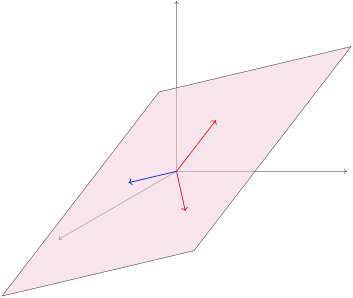
We say that a set of vectors is linearly dependent if one vector in the set belongs to the span of the others. Otherwise, we say the set is linearly independent.
You can think of linearly dependent sets as containing a redundant vector, in the sense that you can drop a vector out without reducing the span of the set. In the above image, all three vectors lay in the same planar subspace, but only two vectors are needed to span the plane, so the set is linearly dependent.
It follows that \(\{\vec v_1,\vec v_2,\vec v_3,\vec w\}\) is linearly dependent because \(x_1\vec{v}_1+x_2\vec{v}_2+x_3\vec{v}_3 + x_4\vec w=\vec{0}\) had the number of solutions you found in the previous task. Which feature of which RREF matrix best reveals this?
The pivot column in the augmented matrix \(\RREF \left[\begin{array}{ccc|c}
\vec v_1 & \vec v_2 & \vec v_3 & \vec w
\end{array}\right]\text{.}\)
\(\RREF \left[\begin{array}{cccc}
\vec v_1 & \vec v_2 & \vec v_3 & \vec w
\end{array}\right]\) (or \(\RREF \left[\begin{array}{cccc|c}
\vec v_1 & \vec v_2 & \vec v_3 & \vec w & \vec 0
\end{array}\right]\)) can be used to solve \(x_1\vec{v}_1+x_2\vec{v}_2+x_3\vec{v}_3 + x_4\vec w=\vec{0}\text{,}\) and the non-pivot column reveals it has infinitely-many solutions.
For any vector space, the set \(\{\vec v_1,\dots\vec v_n\}\) is linearly dependent if and only if the vector equation \(x_1\vec v_1+ x_2 \vec v_2+\dots+x_n\vec v_n=\vec{0}\) is consistent with infinitely many solutions.
A set of \(\IR^m\) vectors \(\{\vec v_1,\dots\vec v_n\}\) is linearly independent if and only if \(\RREF\left[\begin{array}{ccc}\vec v_1&\dots&\vec v_n\end{array}\right]\) has all pivot columns.
A set of \(\IR^m\) vectors \(\{\vec v_1,\dots\vec v_n\}\) is linearly dependent if and only if \(\RREF\left[\begin{array}{ccc}\vec v_1&\dots&\vec v_n\end{array}\right]\) has at least one non-pivot column.
A set of \(\IR^m\) vectors \(\{\vec v_1,\dots\vec v_n\}\) spans \(\IR^m\) if and only if \(\RREF\left[\begin{array}{ccc}\vec v_1&\dots&\vec v_n\end{array}\right]\) has all pivot rows.
A set of \(\IR^m\) vectors \(\{\vec v_1,\dots\vec v_n\}\) fails to span \(\IR^m\) if and only if \(\RREF\left[\begin{array}{ccc}\vec v_1&\dots&\vec v_n\end{array}\right]\) has at least one non-pivot row.
Recall that in Activity 2.2.1 we used the words vector, linear combination, and span to make an analogy with recipes, ingredients, and meals. In this analogy, a recipe was defined to be a list of amounts of each ingredient to build a particular meal.
Consider the statement: The set of vectors \(\left\{\vec{v}_1,\vec{v}_2,\vec{v}_3\right\}\) is linearly dependent because the vector \(\vec{v}_3\) is a linear combination of \(\vec{v_1}\) and \(\vec{v}_2\text{.}\) Construct an analogous statement involving ingredients, meals, and recipes, using the terms linearly (in)dependent and linear combination.
Prove the result of Observation 2.4.9, by showing that, given a set \(S = \{\vec{v}_1,\vec{v}_2,\ldots,\vec{v}_n\}\) of vectors, \(S\) is linearly independent iff the equation \(x_1\vec{v}_1 + x_2\vec{v}_2 + \ldots\ + x_n\vec{v}_n = \vec{0}\) is only true when \(x_1 = x_2 = \cdots = x_n = 0\text{.}\)